Additional information
| Ethnic Groups | |
|---|---|
| Regions | |
| Primary Materials | |
| Materials |
Authentic Art and Ethnographic Objects From Africa / Custom Mounting Services
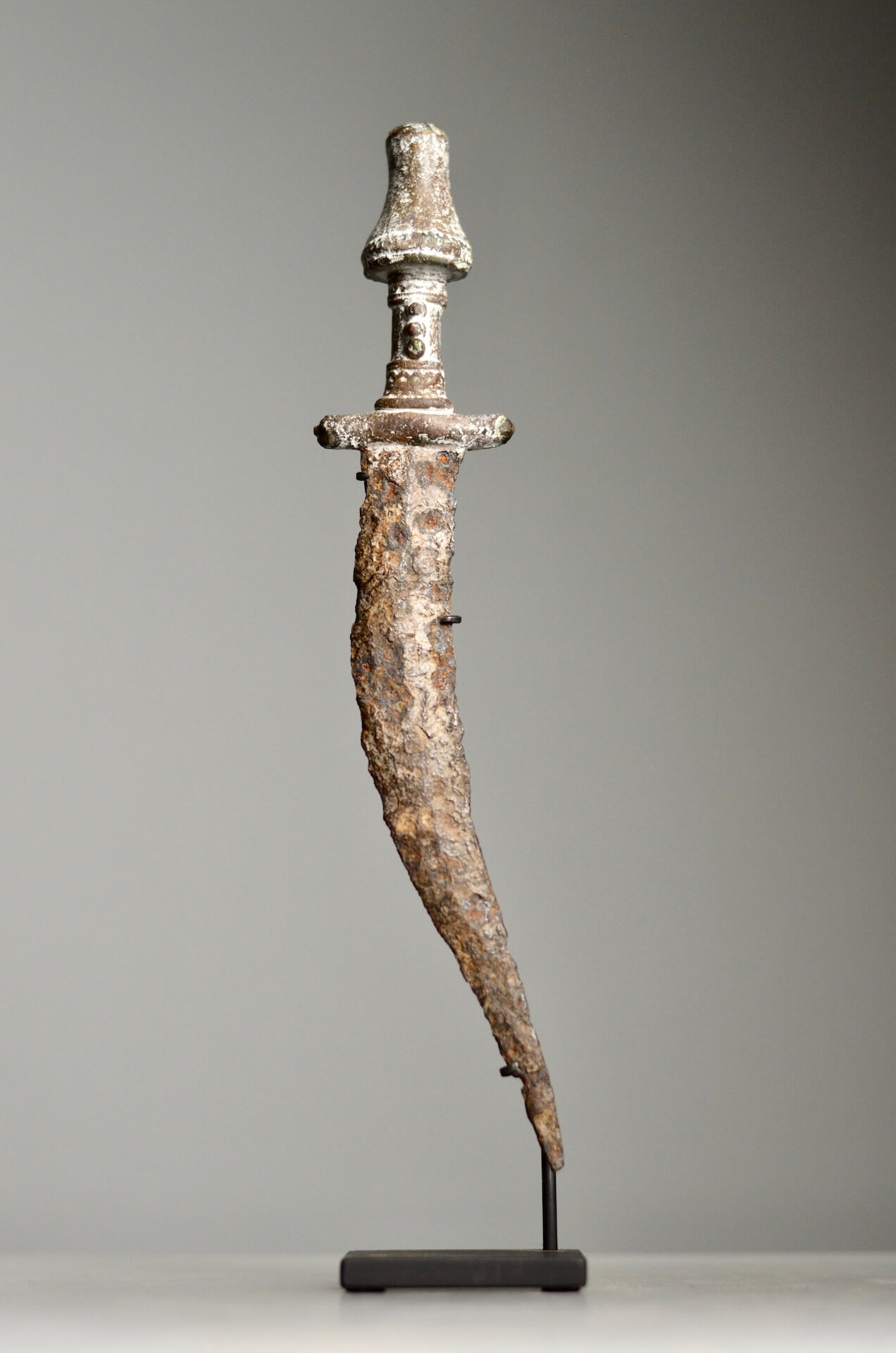


The marrying of lost-wax, cast-copper alloy to iron can be accomplished in several ways. Doing so allows the maker of a knife, sword, or tool to combine the strength and cutting edge of iron with the color, detail, and carrying capacity of relatively lower melt-point copper alloys, creating an impressive handle. A metallurgically advanced technique for combining cast-copper alloy with iron is the method employed in this rare, ancient, and handsome dagger: A blacksmith forms a blade on the anvil, and equips one end with a tang; a wax handle is then built around the tang, sculpted to the desired shape, detailed, and encased in clay. The clay is then dried and fired, hardening the jacket into a hard mold while the wax escapes, creating a void. Molten copper alloy is then introduced into the mold, enveloping the tang and hardening around it to create a handle for the blade. The method takes enormous skill, training, and patience. Each step must be executed with great care to ensure that the resultant work is free of flaws, up to the task for which it was intended, and aesthetically pleasing. A crude knife can be just as sharp and deadly as a beautifully wrought dagger, but a weapon of outstanding craftsmanship and beauty impresses in situations of peace as well as in violent combat.
Dyula (Dioula or Juula) casters were known for their mastery of the technique of casting copper alloys onto steel. The specimen at hand is an excellent example of the technique and the Dyula curvilinear form. Acquired in the 1980s; ex collection Joseph Knopfelmacher, New York. $500
10″
| Ethnic Groups | |
|---|---|
| Regions | |
| Primary Materials | |
| Materials |