Additional information
| Ethnic Groups | |
|---|---|
| Materials | |
| Primary Materials | |
| Regions |
Authentic Art and Ethnographic Objects From Africa / Custom Mounting Services
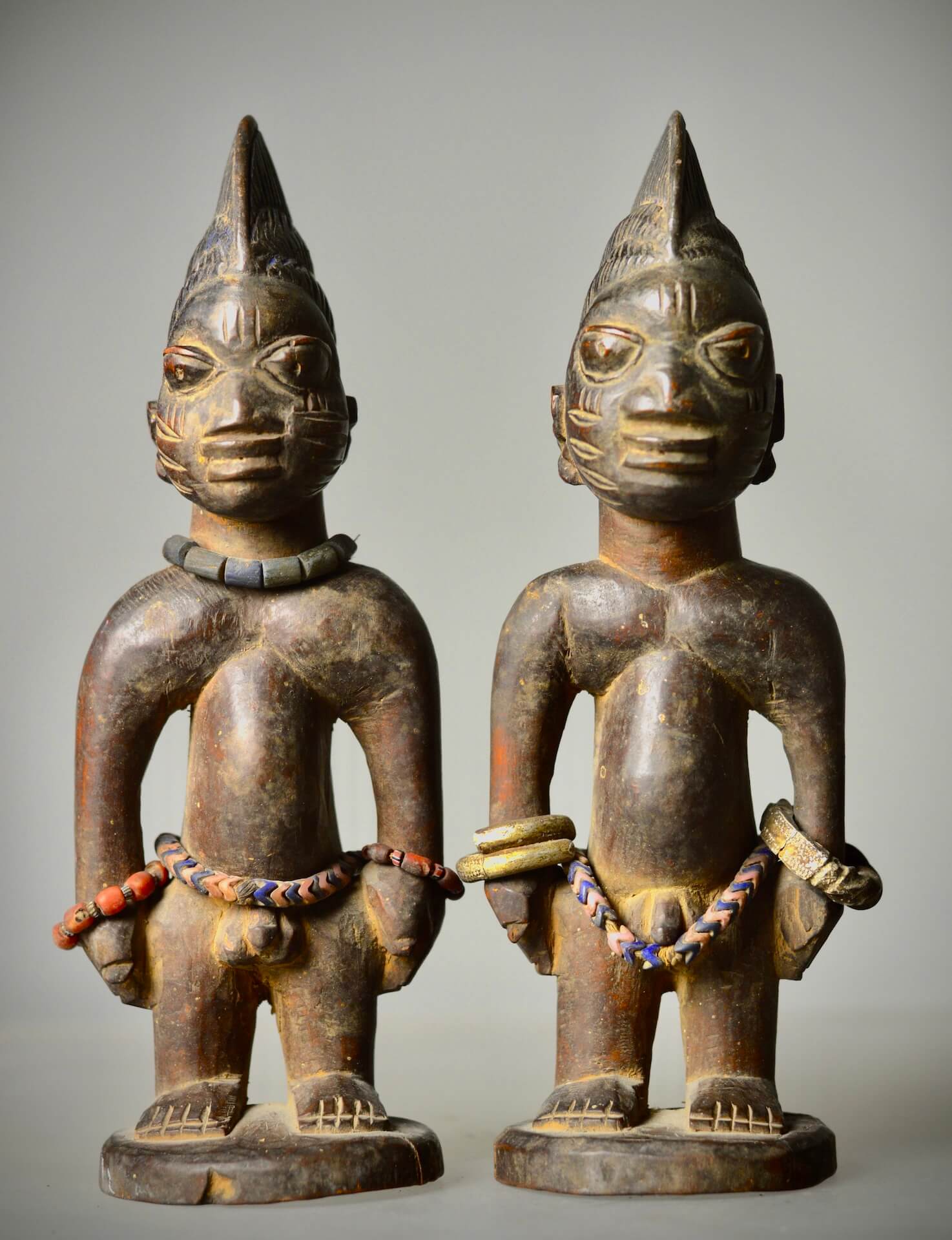


The former owner of this lovely pair of ibejis acquired them from a Yoruba family between 1964 and 1966 during a stint in the Peace Corps. He was posted in Ibadan. After buying some reproduction Benin-style bronzes from traveling Hausa salesmen, the young volunteer discovered that local people had traditional artifacts in their homes which they would readily sell.
He related to me that he attempted to clean the first ibeji he bought and that he immediately regretted it. Rather than simply dusting the figure off with a soft rag, he had opted to relieve it of its perceived dirty surface using soapy water, and was so horrified with the result that he never cleaned another ibeji. In fact, he would never do anything more than lightly dust them off for the next 60 years. The result was a collection of pristine ibeji singles and pairs essentially retaining their as-collected surfaces.
With scant exception, all ibejis on the market today, as well as those in both public and private collections, have passed through the hands of dealers at various levels who could not resist polishing them up. These are among the few that have never been enhanced for the market. Whether or not they remain so for much longer is up to their next caretaker. $800
10″